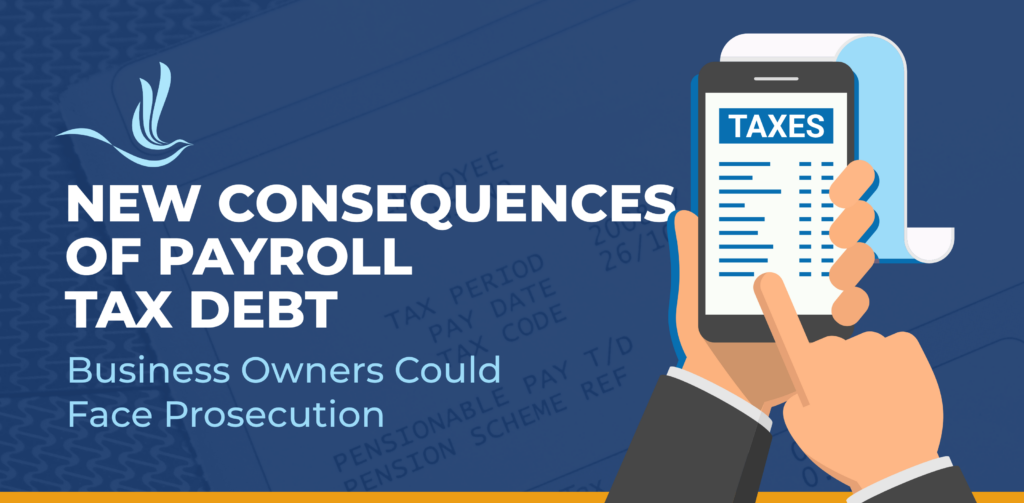
The responsibility of payroll taxes falls on the shoulders of employers, although they come from employee paychecks. The federal government, Social Security and Medicare heavily rely on taxes from employee wages.
IRS revenue officers are now tracking how unpaid payroll taxes were spent during their “trust fund investigation.”
Payroll Taxes Used for the Employer’s Benefit
Employers will now face more penalties for payroll fraud. This can include wrongfully spending payroll taxes or pocketing it for themselves. Maintaining a luxury lifestyle while owing payroll taxes can now lead to prosecution.
Revenue officers are being instructed to pull employer 1040 tax returns to learn whether the money that benefited them was reported as income. If the money was not reported as income, the RO will submit the returns and investigation records to the civil audit division. Another option is that the RO will refer the case to the IRS Criminal Investigation Division to review for criminal prosecution. The course of action made by the RO depends on the severity of the case.
What This Means for Business Owners
Business owners should utilize their tax professionals and seek advise to avoid any possible criminal activity. It’s important to review and track where the payroll money goes for the year. If you know that some of your payroll tax money went to yourself as an employer, you should prepare to amend your income tax returns before the IRS catches up to you.
Avoiding handling this matter could put you in a worse financial situation, or even lead to prosecution.
Payroll Tax Debt
If you are currently in unaffordable tax debt, Optima’s team of tax professionals may be able to aid your case. Affordable Tax Relief is the nation’s leading tax resolution firm with over a decade of experience helping taxpayers with tough tax situations.
With the rise of gas prices and the decline of the housing market, it’s no secret that the United States is experiencing inflation. Inflation doesn’t stop at gas and housing, though, as the state of the economy also impacts your taxes. The IRS updates certain tax provisions annually to account for inflation, so your tax and investment plans should change accordingly.
Inflation and Standard Deductions
Standard deductions rise during inflated tax years. For 2022, the deduction for joint filers is expected to rise to $25,900; an $800 difference. Single filers and married taxpayers filing separately now have a standard deduction of $12,950. This is a $400 difference from last year. Heads of households now have a standard deduction of $19,400 for 2022, which is a $600 difference. The 401(k) limit has been increased as well, making it $20,500.
2022 Marginal Rates During Inflation
The marginal rates (based on income level) are as follows:
Incomes greater than $539,900 ($647,850 for joint filing) have a rate of 37%
Incomes greater than $215,950 ($431,900 for joint filing) have a rate of 35%
Incomes greater than $170,050 ($340,100 for joint filing) have a rate of 32%
Incomes greater than $89,075 ($178,150 for joint filing) have a rate of 24%
Incomes greater than $41,775 ($83,550 for joint filing) have a rate of 22%
Incomes greater than $10,275 ($20,550 for joint filing) have a rate of 12%
Incomes of $10,275 or less ($20,550 or less if filing jointly) have a rate of 10%
Alternative Minimum Tax During Inflation
The AMT tax exemption for the 2022 tax year has also increased due to the economy. It is now $75,900 and begins to phase out when your income reaches $539,900. Married couples filing jointly have a minimum of $118,100 and begins to phase out at $1,079,800.
What You Can Expect
Although the IRS has made some inflation adjustments, several provisions of the tax code have yet to be amended. This means that taxpayers will pay more for the 2022 tax year.
You should review your spending and update your financial plans and investment accounts to avoid problems with the IRS in the future. Not all taxpayers may be affected by the inflation, but some state and federal provisions have not been updated to reflect the times. A tax professional can help you plan according to your state provisions and your current income level.
For Assistance with Tax Debt During Inflation
Our tax professionals will review your case and inform you on how to move forward in your tax relief journey. Affordable Tax Relief has a team of dedicated and experienced tax professionals with proven track records of success.
There is no shame in needing professional help during tax season. In fact, if you’re able to afford tax assistance or find community resources, you’ll have a better likelihood of accurate returns. Getting your return completed correctly the first time means fewer delays and getting your refund faster. Choosing the wrong tax professional, however, could hurt you in the long run. The IRS has shared several tips for choosing a tax professional.
Certified public accountants are licensed by state boards of accountancy in the District of Columbia and U.S. territories. They must pass the Uniform CPA Examination and have completed a study in accounting at a college level. To maintain an active CPA license, it is required that a CPA completes specified levels of continued education.
Tax attorneys are licensed by state courts, the District of Columbia, or designees such as the state bar. If you’re considering hiring an attorney specializing in tax prep, they should still have a degree in law and passed a bar exam.
Tax Professional History
Conducting your own research is crucial to choosing a tax professional. Sources such as the Better Business Bureau can give you some history on the professional that you’re considering. Notable things in their background would be disciplinary actions and the status of their license. The State Board of Accountancy is used for CPAs, the State Bar Association for attorneys, and the IRS verifies enrolled agent status here.
Service Fees for Tax Professionals
The goal of the tax preparer should not be larger refunds than their competitors. Tax preparers that charge by taking a percentage of your refund may not have your best interest in mind. More money sounds great at first, but compliance with the IRS is the ultimate goal. You want to be sure that the tax pro is not using deductions you don’t qualify for, or other means to increase your refund and make more money.
There is never a reason to show your personal documents or Social Security number to a tax preparer when you’re asking about a quote.
Book a Tax Professional Early
You don’t want to wait until the last minute to find a tax professional. As soon as the tax season ends, it’s a good idea to contact a tax preparer for next year. Fly-by-night preparers are high risk investments.
Providing Documentation
Keep records and receipts handy for filing season. This will make the tax preparer’s job a lot easier, and increase the likelihood of accuracy for your return. A good tax preparer should ask questions to figure out your total income and tax deductions, or credits.
Blank Tax Returns, Signing, and Filing
You should never sign a blank tax form, even if the preparer sent it to you. Always review your return thoroughly and ask questions if you’re confused. This is important, you want to make sure the refund is going directly to you, and not through the preparer. They should also provide you with a copy of the completed return.
You also want to make sure that your tax professional e-files your return. Filing electronically and choosing direct deposit is the quickest way for you to get your refund.
Preparer Tax Identification Number
All paid tax preparers must sign returns and include their PTIN, or Preparer Tax Identification Number by law. If your preparer does not have a PTIN, do not move forward with their paid services.
Optima’s Tax Services
Now that you know these tips for choosing a tax professional, you can get help. Affordable Tax Relief has a team of dedicated and experienced tax professionals with proven track records of success.
There are instances where income will not be taxed, whether or not you report it during tax season. Understanding which earnings are taxable versus non-taxable could save you a lot of time and trouble when you file your tax returns.
In order for income to be considered non-taxable, it must be legally exempt.
Taxable vs Non-taxable Income
Some examples of taxable income would be employee wages, or constructively received income. Constructively received income is income that is available to you before the end of the tax year. This could be in the form of cash or deposit.
If an agent receives income on your behalf, this is called assignment of income. Assignment of income is still taxable, even if a third party is accepting your earnings.
Prepaid income is another taxable compensation that may include payment for future services.
Are royalties non-taxable income?
Copyrights, patents, and other properties such as oil and gas are examples of royalties. These items are taxable as income.
Are business and investment earnings non-taxable?
Business earnings such as rental properties and other investments are very much taxable. Business owners are required to pay taxes quarterly to cover Social Security and Medicare tax.
While non-profit agencies are tax exempt, you still have obligations to file a return.
What to do if you have a tax liability?
Taxable and non-taxable income can be a confusing topic. It’s best to ask a professional for assistance if you’re unsure about how or when to report income. Should you find yourself in the midst of a tax liability that is unaffordable, give Affordablea call at (800) 536-0734 for a free consultation.
If you’re facing financial hard times, your retirement funds begin to look like a good source of much-needed cash. In cases of dire emergency, you may indeed be able to make withdrawals from those funds before you reach retirement age. However, the potential short-term and long-term consequences can be severe. Nonetheless, if you must make an early withdrawal from an Individual Retirement Account (IRA) or 401(k), there are certain circumstances under which you can minimize the bite by Uncle Sam.
The COVID-19 pandemic and the 2020 CARES Act have made it easier for taxpayers to withdraw funds from their retirement accounts. Learn more about taking a CARES Act retirement withdrawal HERE.
3 Types of Retirement Funds
There are three primary types of tax-optimized retirement funds in the United States:
Traditional IRAs
Roth IRAs
401(k)s
Traditional IRAs
Traditional IRAs are drawn from pre-tax earnings. When you deposit funds in a traditional IRA, the taxes on those funds and your earnings are deferred until after you retire, presumably when your income is lower and you qualify for a lower tax bracket.
Roth IRAs
By contrast, Roth IRAs are drawn from post-tax earnings. Because you pay taxes on Roth IRA deposits upfront, you do not have to pay taxes on either the principal or the earnings, provided that your Roth IRA has been open for five years or longer and you are at least 59 ½ years old when you begin making withdrawals.
401(K)
401(k) funds are sponsored by your employer. You can invest either pre-tax earnings or post-tax earnings, with tax implications similar to those for a traditional or a Roth IRA. Many employers match their employees’ contributions dollar for dollar. The catch is that you can’t access your employer’s contributions to your 401 (k) until you are fully vested in the company, which translates to being employed for a certain length of time which varies but five years is common.
For what reasons can you withdraw from an IRA without penalty?
If you are younger than age 59½, taking withdrawals from either a traditional or Roth IRA or from a 401(k) will usually trigger a 10 percent tax penalty in addition to paying any income taxes that are due. However, there are exceptions that vary depending on whether you are withdrawing from a traditional or a Roth IRA or from a 401 (k). You can avoid tax penalties from withdrawing from a traditional IRA even if you are younger than age 59 ½ for the following reasons
Purchasing a first home.
Educational expenses for yourself or a family member.
Death or disability of a family member.
Covering unreimbursed medical expenses.
Purchasing health insurance coverage (only if you are not already covered).
To claim one of these exceptions, you will need to complete IRS Form 5329 along with your income tax returns the following year. Even if you avoid the penalty, you will still need to pay taxes on the money you withdraw. This means that you should withdraw enough to cover your needs, plus a little extra for taxes.
Is there a Roth IRA withdrawal penalty?
Yes, penalty-free early withdrawals for Roth IRAs apply to only two circumstances: first–time home purchase or death or disability of a family member. However, the penalty for early withdrawal from a Roth IRA only applies to earnings, since you have already paid taxes on the principal. You will also need to submit Form 5329 along with your tax return.
How do I avoid an early withdrawal penalty on 401(k) retirement funds??
It is possible to make early withdrawals from a 401(k). However, the IRS is especially harsh on early withdrawals from 401 (k) funds. You may make what are known as hardship withdrawals before age 59 ½ for the following reasons:
Purchase a first home.
Pay for college for yourself or a dependent.
Prevent foreclosure or eviction from your home.
Cover unreimbursed medical expenses for yourself or a dependent.
However, hardship withdrawals from a 401 (k) differ from hardship withdrawals from an IRA. You will be assessed a 10 percent penalty in addition to paying income taxes on your withdrawal. To avoid the 10 percent penalty on early withdrawals from a 401(k), you must fulfill one of the following circumstances.
Total disability.
Medical expenses that total more than 7.5 percent of your adjusted gross income (AGI).
Court order to give the money to a divorced spouse, child, or other dependents.
Permanent separation from your job (including voluntary termination) during or after the year you turn 55.
Permanent separation at any age with a plan for equal yearly distributions of your 401(k) (once you begin taking distributions, you must continue them until you reach age 59 ½ or for five years, whichever is longer).
A better option than a hardship withdrawal from your 401(k) may be to take a loan against the value of your 401(k) with an outside lender. The lender places a lien against your 401(k) which remains in place until you repay the loan. Your funds remain in your 401(k), safe from the reach of Uncle Sam. However, if you default on the loan, the lender will have the right to seize your 401(k) to collect payment.
Is it bad to withdraw from an IRA?
It should be clear that IRA and 401k withdrawal should be considered a last resort. Even if you avoid tax penalties, you are depleting the available funds available for your retirement so in this sense, it is a bad idea and if you can avoid it, you should. If you must borrow, borrow enough to cover your obligations plus taxes, and repay the funds as quickly as possible. After all, you are actually repaying yourself – and your future.
Need to speak with a licensed tax professional? Affordable Tax Relief provides a comprehensive range of tax relief services. Schedule a consultation with one of our professionals today.